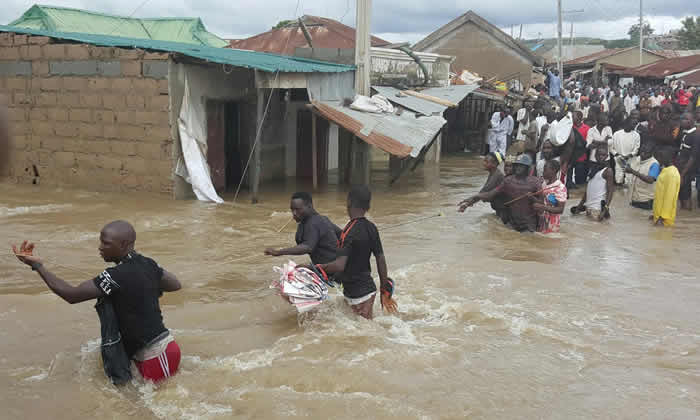
Anambra intensifies flood awareness and early warnings as NiMet predicts days of heavy rain. Government says measures are in place to reduce disaster risk
The Anambra flood emergency response is now in full motion as the state government activates strategic measures to mitigate the risks of flooding ahead of forecasted heavy rainfall.
Speaking in Awka on Saturday, Commissioner for Environment, Dr Felix Odimegwu, affirmed that the government is fully prepared to handle any flood-related emergency, noting that precautionary steps are already being implemented across vulnerable areas of the state.
This development follows the Nigerian Meteorological Agency’s prediction of a three-day rainfall pattern across the country, with Anambra identified as one of the high-risk states.
Residents of Onitsha are already on edge after torrential rains earlier in the week submerged major streets including Zik’s Avenue and Iweka Road near the bustling Ochanja Market. The flooding halted commercial activities and left traders struggling to save their goods from waterlogged shops.
Dr Odimegwu said the Ministry of Environment has intensified public sensitisation campaigns and issued early warnings to communities, especially those located near coastal and riverine areas.
“After the NiMet seasonal prediction, we immediately disseminated information and advised residents to prepare. Those living near the rivers were specifically warned about the possibility of displacement,” he stated.
He emphasised that the root cause of urban flooding often lies in human negligence, particularly the blocking of drainage channels. “We have consistently sensitised the public to keep waterways clear. Flooding caused by poor waste disposal is preventable, and that’s our focus,” the commissioner said.
To bolster state preparedness, Governor Chukwuma Soludo has activated a multi-agency taskforce led by the Deputy Governor, Dr Onyekachi Ibezim.
The committees, formed after the devastating 2022 flood that affected nine local government areas, comprise officials from the ministries of health, information, education, environment, and emergency management, alongside local government chairpersons.
Dr Odimegwu revealed that since then, Anambra has developed a proactive system of weekly early warning alerts targeting farmers, traders, and residents.
These alerts are designed to help people adjust their plans and harvest crops before floods strike. “Early warning gives farmers time to harvest and traders time to protect their stock. It helps civil servants plan their movement and avoid getting stranded,” he noted.
He also introduced a physical flood-level monitoring device, locally known as ‘Marking’, which has been installed in flood-prone zones.
“The object shows three colour indicators: green means safety, yellow signals caution, and red represents imminent danger. Once we reach yellow, we start relocating people to safer grounds,” he explained.
The commissioner assured that these measures would reduce the scale of potential devastation if flooding occurs again this year. “We vowed that such disaster cannot occur again, but if it does, the effects will not be as severe as in 2022 because of the structures we now have in place,” he said.
With the peak of the rainy season approaching, Anambra’s efforts signal a commitment to disaster resilience. Authorities are urging residents to heed advisories, cooperate with officials, and play their part in preventing man-made flooding. As the rains fall, the state remains on alert—ready to act, prepared to protect.